
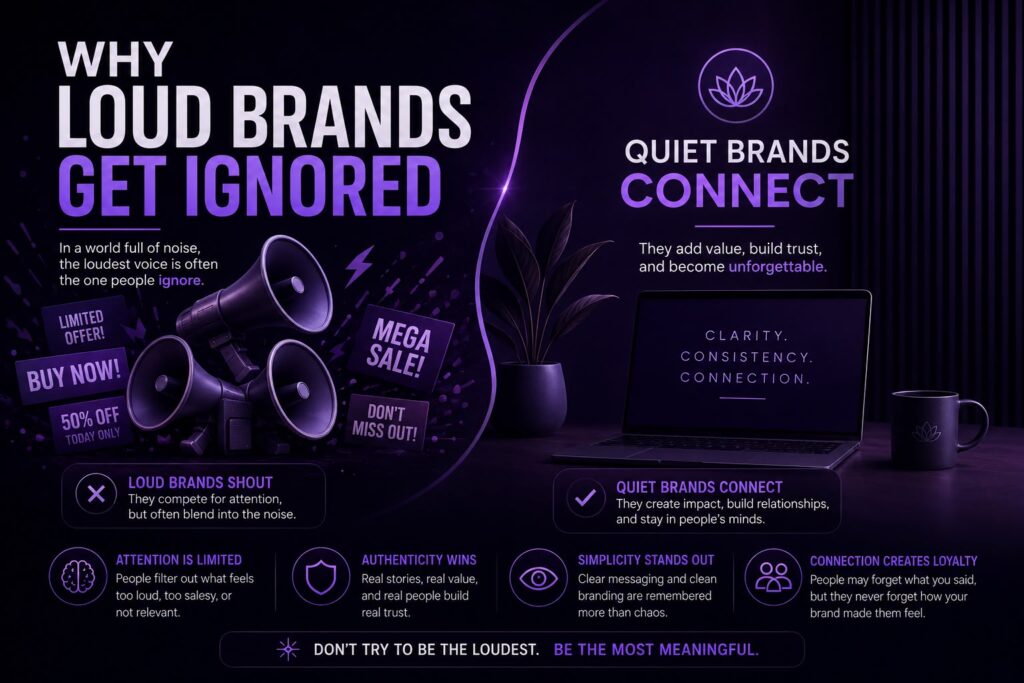
For a long time, businesses operated under the belief that to succeed in marketing, they needed to be the loudest voice in the room. The reasoning was straightforward: the more noise you made, the more attention you would attract, and in turn, the more customers you’d gain. This led to a wave of brands creating extravagant advertisements, eye-catching campaigns, and a constant barrage of promotional content. There was a time when these strategies could effectively capture attention since consumers were exposed to far fewer marketing messages than they are today.
However, the digital age has transformed the way we consume information. Nowadays, consumers are bombarded with a nearly endless array of advertisements, notifications, videos, social media posts, emails, and sponsored content fighting for their attention at all hours. From the moment we wake up and check our phones to the last scroll on social media before bed, businesses are vying for our focus. This overwhelming abundance of messaging has made people increasingly selective about what they engage with.
This shift presents a surprising contradiction: while brands are louder than ever in their attempts to stand out, audiences are becoming experts at tuning out the noise. What once grabbed attention can easily fade into the background. The very strategies designed to boost visibility can inadvertently render brands forgettable.
The Impact of Constant Noise
Human attention is finite. Regardless of the information overload, we’re only capable of processing so much before we start filtering out the excess. This filtering often happens instinctively. When confronted with frequent promotional messages, our brains learn to disregard content that seems repetitive, overly pushy, or lacking any real value.
Consider your own online experiences. How many ads do you scroll past each day without a second glance? How many promotional emails sit unopened in your inbox? How often do you skip those pre-roll ads before a video? These behaviours are entirely natural responses to a world overflowing with information.
Many brands mistakenly believe that turning up the volume on their marketing will lead to better results. In truth, the opposite can occur. When businesses relentlessly push sales-driven messages without adding value, audiences simply tune them out. The content becomes predictable, and let’s face it, predictability doesn’t often grab attention.
In this information-saturated world, consumers are looking for relevance, not just more noise.
The Shift Towards Authenticity
One of the most notable trends in recent marketing is the increasing demand for authenticity. With access to more information than ever, consumers can easily compare products, read reviews, and research companies. This wealth of information has made people more informed—and more sceptical—about traditional marketing techniques.
Today’s consumers don’t want to feel as though they’re being sold to with every brand interaction. Instead, they seek connections with brands that feel genuine, trustworthy, and open. They value businesses that communicate honestly, share relevant insights, and prioritise relationships over immediate sales.
Authenticity fosters trust—a valuable commodity for any business. When customers trust a brand, they are more likely to engage with its content, advocate for it, and remain loyal over time. This loyalty isn’t something that can be achieved through loud marketing alone; it’s cultivated through consistent, genuine actions and meaningful communication.
Brands that emphasise authenticity often find that they don’t need to fight for attention. Their audience is naturally drawn to them because a relationship has already been established.
Embracing Simplicity in Branding.
Many loud brands struggle to connect with their audiences because they equate complexity with effectiveness. They often overwhelm their messaging with too much information, busy visuals, and conflicting calls to action. Ironically, while they aim to communicate more, they often end up creating confusion.
Simplicity has emerged as a powerful tool in branding, providing clarity. When a brand communicates its message clearly and consistently, audiences can easily grasp who they are, what they stand for, and why it matters. This clarity builds trust and makes it easier for people to remember the brand.
Successful brands embrace simplicity not because they lack ideas but because they recognise the importance of focus. Their messaging feels intentional, their visual identity streamlined, and their content serves a clear purpose. By narrowing their target audience, they communicate effectively with the individuals who matter most.
In today’s cluttered digital landscape, simplicity often garners more attention than complexity because it offers audiences something increasingly rare: clarity.
Confidence Without the Volume
It’s crucial to distinguish between confidence and mere loudness. Loud brands often operate from a sense of urgency, feeling compelled to shout to be heard. In contrast, truly confident brands communicate their message with assurance, allowing their authenticity and simplicity to shine through without overwhelming their audience.